Inside the Exoskeleton: A Blueprint for Legal Teams Built for What’s Coming
Four layers, one feedback loop, and why this compounds over time.


In my previous piece, I described the tsunami: legal intake about to increase by an order of magnitude, the old model guaranteed to break under that volume, and most of the solutions currently being marketed to legal teams rowing faster in the same sinking boat. The argument was that the answer is not technique. It is architecture.
This piece describes what that architecture looks like.
The exoskeleton is not a set of tools. It is a system designed around the two things that actually matter — attention and judgment — that routes work to the right layer automatically, without requiring a lawyer to make that routing decision manually each time. It is built on a simple premise: most of what we consider legal work today does not need a lawyer, and the work that does need one deserves better than the depleted, context-switched, fifteen-minutes-between-meetings version that the current model delivers.
What follows is a high-level blueprint. The specific components — the agents, the skills, the infrastructure — are the subject of a later piece. Here the focus is on what the layers are, why each one exists, and how work flows through the system.
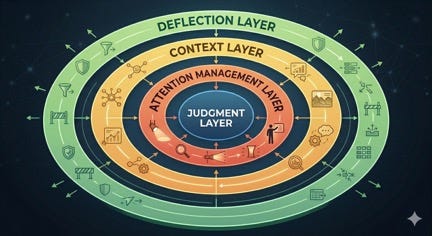
Layer A: The Deflection Layer
This is where “wrong-number,” “googled it for you” or “try again” tasks go, and where they stay.
Every legal team receives work that should never have reached them: requests that belong to another function, questions answerable by a self-serve resource, tasks so administrative that zero legal expertise is required. Under the current model, these arrive in the same queue as everything else, consume attention in the triage process, and often get handled by lawyers because it is faster than redirecting them. That is waste — not because the work is unimportant to the person asking, but because legal judgment is not required and should not be expended.
The Deflection Layer exists to intercept this work before it reaches a lawyer’s attention. Its goal is full automation: work that enters here either gets resolved without human involvement — a drafted reply, a pointer to the right resource, a redirect to the function that actually owns it — or it gets returned to the sender with clear guidance on what is needed before it can proceed.
One example of a component that lives here: a sales rep who emails Legal asking for the company’s standard payment terms gets an instant reply with the answer and a link to the approved template. A request to review a vendor contract that arrives without the contract attached gets returned automatically with a single question. Neither reaches a lawyer.
The Deflection Layer exists to protect everything below it. Its success is measured not by what it handles but by what it prevents from reaching the layers that matter.
Layer B: The Context Layer
A significant portion of what slows down legal judgment is not the judgment itself — it is the setup. Finding the last three versions of this agreement type. Checking what position the company took on this clause in the last negotiation. Pulling the relevant regulatory framework. Loading the relationship history. This pre-work is real and necessary, but it does not require senior legal expertise. It requires information retrieval, pattern matching, and first-cut application of known positions — work that can be systematized.
The Context Layer does this work automatically. When a substantive matter enters the system, Layer B assembles the relevant context: precedents from the knowledge base, applicable playbook provisions, a first cut based on straightforward application of the company’s standard positions, and any flags where the matter deviates from the norm. By the time the matter reaches a lawyer, the setup is done.
Juniors should spend significant time in this layer. It is where pattern recognition is built, where legal instincts are developed through repeated exposure to how problems are structured and solved. For junior lawyers, the Context Layer should function as scaffolding — providing structure, surfacing the right precedents, flagging where a situation departs from the standard, and creating clear escalation paths when the first cut hits its limits. The layer does not replace the learning; it accelerates it by ensuring the right information is present when judgment is being formed.
Senior lawyer time, by contrast, is not well spent on the assembly work. A senior exoskeleton looks different from a junior one — it assumes the knowledge, skips the scaffolding, and focuses on packaging context to maximize judgment quality in the time available. The goal is not to surface everything relevant but to surface the right things in the right order. The lawyer arrives at the judgment task already loaded, not still loading.
The Context Layer also handles post-work — and this is one of the most important design decisions in the whole system. After a lawyer exercises judgment at Layer D, the matter should flow back to Layer B for capture: what was decided, how it deviated from the playbook if at all, and whether the deviation is frequent enough that the playbook itself needs to change. Most legal teams handle this informally if at all. The lawyer moves on to the next thing. The institutional knowledge evaporates. The exoskeleton closes that loop by making capture a designed step rather than an optional aspiration.
The feedback loop back to Layer B is what makes the exoskeleton more useful over time. Every matter that flows through the system makes the next one faster. The knowledge base deepens. The first cuts improve. The playbooks evolve. This is the compounding effect that separates a system from a set of tools.
Layer C: The Attention-Management Layer
Most legal teams call what this layer does prioritization. It is more precise to call it attention protection — and it is the layer that existing legal technology has almost entirely ignored.
The market is full of tools designed to help lawyers do things faster. Drafting assistance, review automation, research acceleration. What none of them address is the prior question: should this lawyer be looking at this matter right now? That decision — when attention gets deployed, on what, in what order, in what sized window — is still left entirely to human discretion. And human discretion under pressure, managing a queue of uniform pings for non-uniform matters, produces exactly the misallocation described in the previous piece. The loudest person from sales gets the NDA reviewed first. The high-stakes product counseling question that arrived quietly at 4pm gets fifteen minutes at the end of an already depleted day.
The Attention-Management Layer addresses this directly. It manages not just what is in the queue but the conditions under which work reaches a lawyer. Does this matter require attention and judgment right now, or can it be batched with similar work later? Does the available window fit the size of what this matter actually requires — and if not, should it wait for a deeper block? Is this a recurring task that should run on a scheduled cadence entirely, coming off the mental to-do list and the ambient mindshare it quietly occupies?
Critically, it does this at the individual level. It knows that this lawyer reserves her mornings for deep focus work because that is when her attention is sharpest — while her teammate’s mornings are consumed by back-to-back calls to accommodate European timezone colleagues, making afternoons her window for substantive work. Same team, different exoskeletons, because the same ping landing at 9am means something different depending on who receives it and what their day looks like.
The distinction from existing tools is precise. A dashboard tells you what is in the queue. The Attention-Management Layer tells you what the queue should look like given your available attention — dynamically, not through a static priority matrix. It treats different-sized matters differently rather than surfacing everything as an equally urgent notification. It batches the batchable, schedules the schedulable, and reserves deep blocks for the work that cannot be compressed. And it does all of this according to macro preferences the lawyer sets — what matters most, what can wait, what should never interrupt — rather than requiring moment-to-moment reactive judgment calls that consume the very resource they are supposed to protect.
This is not a productivity feature. It is the layer that makes everything downstream work — because a lawyer who arrives at Layer D having been protected from unnecessary switching, and who got there at the right moment in her day rather than in a gap between other things, is not the same lawyer as one who fought through the queue to get there.
Layer D: The Judgment Layer
Most lawyers did not join the profession to manage dashboards or babysit NDA reviews. They joined because they like to think — hard, about hard problems. The complexity, the nuance, the moment when you see something in a contract that nobody else caught, or when you find the argument that changes the outcome. That is the work. Everything else is the price of admission.
The problem is that in most legal functions, time at this layer has to be hard fought. It gets crowded out by the reactive, the administrative, the low-judgment-high-attention work that fills the queue faster than it can be cleared. The lawyer who wants to spend the morning thinking carefully about a significant commercial negotiation instead spends it triaging, redirecting, and managing the inbox. Layer D is always the intention. It is rarely the reality.
The exoskeleton changes that arithmetic. By the time work reaches this layer, everything that could be handled elsewhere has been. The wrong-number work has been deflected. The context has been assembled — precedents surfaced, first cut waiting, flags visible. The timing has been managed so the lawyer arrives here with a real block available, not a gap between other things. Nothing is competing for attention that should not be.
What that unlocks is something that gets talked about too rarely in the context of legal practice: presence. The ability to give a problem one hundred percent of your thinking, not the fraction that survives after everything else has taken its share. To get into flow — that state where the work stops feeling like work and starts feeling like the reason you chose this profession. To sit with a hard problem long enough that the genuinely good answer emerges rather than the fastest defensible one. Done right, the practice becomes — and this is not too strong a word — joyful.
What the lawyer brings to this layer, and what no part of the exoskeleton can substitute for, is the judgment itself and the accountability that follows. The ability to hold the facts, the risk, the relationships, and the strategic context simultaneously and reach a considered position. The experience to recognize when something looks like a standard situation, but is not.
Everything else in the exoskeleton exists to serve this layer. Its success is measured not by how much work flows through it but by the quality of what comes out — advice that is considered, consistent, and grounded in full context rather than delivered in a depleted fifteen-minute window between two other things.
How Work Flows Through the System
The layers are most useful understood in motion. Here are four examples of how different types of work route through the exoskeleton.
The wrong number
A business team asks Legal to handle something that is not a legal question — an HR matter, a finance process, an operational decision that got routed to the wrong inbox. It enters at Layer A. The system identifies it as out of scope, drafts a reply directing the sender to the right function, and closes the loop. A lawyer never sees it. Time spent: zero.
The standard NDA
A third-party NDA arrives — standard form, counterparty paper. It enters Layer B: precedents pulled, company positions on key clauses surfaced, a first cut generated based on the playbook. If it falls within known parameters — the deviations are within acceptable range, nothing novel — it routes back toward Layer A for automated response or execution with a light human check. If it contains something outside the playbook, it flags for Layer D with full context pre-loaded. The lawyer who touches it, if one is needed at all, arrives with everything ready.
The complex matter that arrives incomplete
A high-stakes matter comes in — a significant product feature review, a regulatory question with real exposure — but the request is missing information needed to work with it. Layer A intercepts it and returns it to the sender with specific questions. Once complete, it enters Layer B for context assembly, then Layer C for timing and batching, then arrives at Layer D with full context and in an appropriate work block. The lawyer engages fully prepared.
The important matter that can wait
A significant matter arrives, but it is not urgent today. Layer B assembles the context immediately — nothing is lost, no one needs to reload anything later. Layer C holds the matter until a deep work block is available rather than surfacing it in the next fifteen-minute gap. The lawyer engages at Layer D fully prepared and unhurried. The quality of the judgment is better for having been protected from the pressure of false urgency.
What This Actually Creates
These layers are not a productivity stack. They are the infrastructure of default good decisions — a system that handles the predictable correctly and consistently, every time, without requiring a lawyer’s attention, so that lawyers are available and fully resourced for the unpredictable.
Most of this infrastructure is invisible to the business. The NDA gets turned around. The wrong number gets redirected. The recurring compliance task runs on schedule. Nobody notices — which is exactly the point. The exoskeleton is not designed to be visible. It is designed to ensure that what is visible — the legal advice that reaches the business — is the best version of what the team can produce.
Over time, the feedback loop changes the economics of the whole system. Every decision captured in Layer B makes the next first cut better. Every playbook update means fewer matters that need to escalate to Layer D. Every recurring task automated means more sustained attention available for the work that actually requires it. The exoskeleton does not just process work. It learns from it — and that compounding is what makes it genuinely different from a set of faster tools.
The next piece goes into the specific components: what agents and skills live at each layer, how to build them without breaking what is already working, and where to start if you are building this from scratch.
Natalie Kim
Natalie is the founder of Inflection Advisory and works with organizations on AI acceleration and governance. As VP Legal at Omnidian she led a full-arc enterprise AI adoption.
The Judgment Layer publishes on AI governance, board accountability, legal intelligence, and the judgment no algorithm is taking from you.