If a Tsunami Is Coming, Do You Row Faster?
Legal intake is about to 10x. The old model won’t hold.

Legal intake is about to increase by an order of magnitude. Not gradually or eventually. Every business team, every client, and every counterparty now has access to AI tools that generate contracts, questions, requests, and escalations faster than any human team could previously produce them. I see it already — in sharp increases in corporate OKR targets, in engineers running multiple agents to produce code while they sleep, in inbound questions that arrive with an AI-generated answer already attached, asking Legal to validate what the client already “knows.”
A tsunami is coming. And most legal teams are responding the way that has worked before but is guaranteed to fail in the age of agentic AI: they are preparing to row faster. More requests processed, more contracts reviewed, more questions answered — and still falling further behind. Not because they are not working hard enough. Because they are optimizing the wrong thing.
The solution does not lie in doing old things better. It requires taking a hard look at what legal teams are actually in the business of dispensing.
The Model We Have Been Running
For decades, legal teams have organized work around two variables: urgency and risk (synonymous with importance). The Eisenhower quadrant — urgent and important, important but not urgent, urgent but not important, neither — is the implicit operating model of most legal functions. Sort by what is on fire and what could become a fire. Attend to both. Delegate or defer the rest.
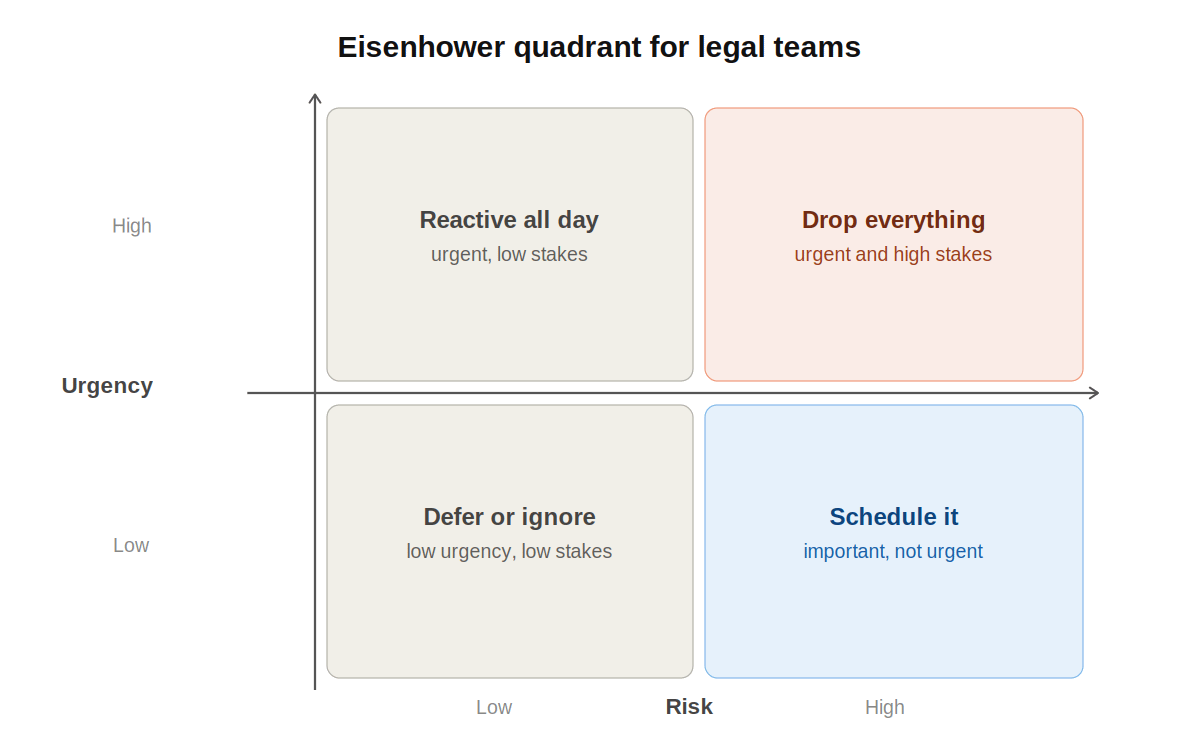
This model made sense when intake arrived at human speed. A lawyer could read the queue, apply judgment to what was in it, and make reasonable decisions about what needed attention now versus later. The sort variables — urgency and risk — were imperfect but workable proxies for where to direct effort.
Two broad categories emerge in practice. The first is reactive teams: lawyers living permanently in the urgent quadrant, putting out fires all day, never surfacing long enough to see what is coming. Ever been in teams where people are perennially late to meetings, harried and claiming “the day got away from them”?
The second is more organized teams that schedule and prioritize — but still using urgency and risk as the primary sort variables. The latter (making space for blue amidst the demands of red and gray) is definitely preferable to the former (spending all day on red and gray with not enough time for blue). Nevertheless, suboptimally prepared for what’s to come.
Here is the problem: urgency and risk are client-side variables. Legal does not control them. A counterparty’s deadline, a business team’s anxiety, a deal’s perceived stakes — these are inputs that arrive from outside and cannot be relied upon to reliably indicate where legal attention is genuinely required.
The Eisenhower quadrant was designed for human-speed intake. Agentic AI breaks both of its underlying assumptions simultaneously: the assumption that you can see what is coming, and the assumption that the volume is reviewable.
The model is not just imperfect. In the age of agentic AI, it is the wrong frame entirely.
The Real Scarce Resource
Here is the reframe that changes everything: what legal teams are actually dispensing is not time. It is attention and judgment — and the two are more interdependent, and more fragile, than most legal operating models acknowledge.
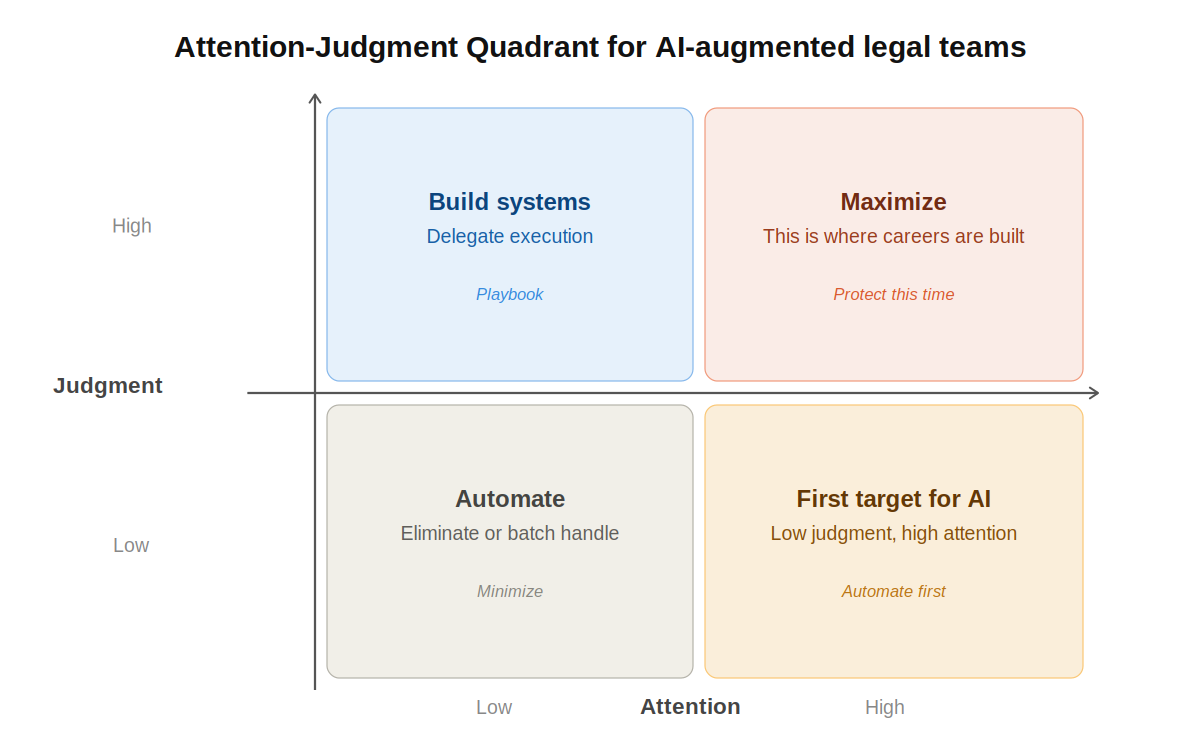
Attention is the cognitive act of engaging with something — reading it, holding it, deciding what it means. Judgment is the application of expertise, precedent, and context to reach a position that protects the organization and moves the business forward. These are the things that cannot be scaled, replicated, or automated in any meaningful sense. They are what clients and business partners actually need from their legal teams. They are also in acutely finite supply, and are the scarcest resource in any legal function.
Attention is finite. This is not a productivity platitude — it is a physiological fact that has gotten more acute, not less, as the pace of work has accelerated. The average knowledge worker’s capacity for sustained, focused attention is shrinking. Notifications, context-switching, and the ambient pressure of a full queue are not neutral — they actively consume the cognitive resource that legal work depends on. You cannot manufacture more of it. You can only allocate what exists.
What makes this more than a wellness concern is that attention is a leading indicator of judgment quality. You cannot exercise good legal judgment in a depleted state. Judgment requires depth, context-loading, and enough uninterrupted time to actually think — to hold the facts, the risk, the relationships, and the precedent in mind simultaneously and reach a considered position. That cannot happen in fifteen minutes between meetings. It cannot happen when you are already three things behind. The quality of the judgment a lawyer delivers is directly downstream of the quality of attention they brought to the problem.
Attention also degrades if it is chronically misallocated. Too much time spent on low-judgment, high-attention work — the kind that requires eyes on it but not real expertise — erodes the capacity for the harder work. The lawyer who spends the morning babysitting routine reviews and on manual dashboard updates does not arrive at the afternoon’s high-stakes product counseling question in the same condition as one who did not. This is not a discipline problem. It is a systems problem. Attention needs to be managed actively, not treated as an infinite input to be consumed by whatever arrives first.
The problem compounds further because attention does not just deplete — it leaks throughout a workstream in ways that are rarely accounted for. Every interruption requires context-reloading: rebuilding the facts, the risk posture, the relationship history, the open questions. That reload is not free. A lawyer pulled off a complex negotiation to handle an urgent intake question does not return to the negotiation at the same depth they left it. Add to this the informal, memory-dependent way most legal knowledge is managed — precedents that live in someone’s head, decisions that were never documented, lessons from last quarter’s deal that never made it into a template — and the problem is not just depletion but inconsistency. The same situation gets handled differently depending on who picks it up, when, and what else is competing for their attention. And because lawyers tend to move onto the next thing rather than capture what they learned from the last one, that inconsistency compounds over time. The institutional knowledge that should be making the team smarter with every matter handled evaporates instead.
Quality of legal judgment, compounded over time, becomes the quality of the risk infrastructure of an organization. Little lapses here and there compound to an unstable foundation prone to damage.
And yet that is precisely what the Eisenhower model produces. Urgency and risk are the sort variables — but both are client-controlled. The counterparty’s deadline, the business team’s anxiety, the perceived stakes of the deal — these inputs determine what gets a lawyer’s attention, in what order, and for how long. The result is systematic misallocation: twenty minutes babysitting an NDA review, only fifteen minutes on the high-stakes product counseling question that actually needed an hour. Not because anyone made a bad decision. Because the model does not distinguish between workstreams that require judgment and workstreams that merely require attention — and so both get treated the same way.
That has always been a problem. With volume about to increase by an order of magnitude, it is about to become an acute one.
The Tsunami
Agentic AI is already in the hands of every team that works with Legal: sales, finance, product, HR, procurement. They are generating contracts, requests, questions, and escalations at a pace that was not possible before — and most of them do not know, and do not need to know, what happens on the other side of the send button.
Picture what that queue looks like at 10x volume:
Sales using their own AI stack to chase 10x leads, with your inbox full of NDAs first thing in the morning (of course, third-party form with buried non-standard indemnification language);
Product and engineering is shipping features for your team to review at 10x the pace, automating product requirements document production with shorter turnaround times;
Contract counterparties using AI turns your MSA redlines around in a day instead of three weeks, with your sales team asking why we can’t meet that velocity;
Everyone from CEO down creating agents that help with their work, talk to each other, and asking (or sometimes, not even asking) what guardrails they should follow.
Some will carry genuine legal risk that could cost the company significantly. A small amount will need immediate judgment. The problem is that on today’s tools, you cannot tell which is which without looking. And looking costs the thing you have least of.
This is not a metaphor for gradual change. It is a structural break — a shift in the volume and velocity of what hits legal functions so significant that the existing model’s basic premise, that a lawyer can see what is coming and make considered decisions about it, no longer holds. Teams that are already reactive will be underwater. Teams running an organized version of the old model will find their system breaking down not because they did anything wrong but because the system was not designed for this input rate.
The instinct — understandable, almost universal, and deeply embedded in how legal has always responded to pressure — is to prepare to row faster. Better dashboards. More AI-assisted intake. Smarter routing. Faster review. These are real improvements. They are not sufficient.
Why Most Solutions Are Still Rowing Faster
The market’s current answers to this problem are largely built on the same underlying assumption as the model they are trying to improve: that a human needs to review the output and make the call, with AI assisting the process. Dashboards that surface what is in the queue faster. Intake forms that pre-categorize requests for human review. Redline suggestions that a lawyer reviews and accepts or rejects. AI-generated summaries that reduce reading time before a human decides what to do.
These tools make the existing model more efficient. They do not change the model. And in failing to change it, they leave the underlying problem untouched: lawyers are still not deploying their attention and judgment where it actually matters — and the advice their clients and companies receive is weaker for it.
The issue is not that human-in-the-loop is wrong. It will always be required. The issue is that these solutions make three false assumptions about the humans in that loop. The first is that human review looks the same as supervising junior lawyers — that a lawyer can dip into a redline or an intake flag, make a call, and move on at low cognitive cost. It does not work that way. Every review requires context-loading. Every context-load costs attention. And attention spent on routine supervision is attention not available for the work that requires genuine expertise. The second assumption is that context-switching is costless. It is not. A lawyer pulled from a complex negotiation to handle an urgent intake flag does not return to the negotiation at the same depth they left it. These tools are designed as if lawyers can toggle between high-judgment and low-judgment work without penalty. The research on switching costs says otherwise — and every experienced lawyer knows it from feel, even if the system they work in ignores it. The third assumption is that lawyers want to do the administrative work these tools generate. Most do not. Dashboard management, status tracking, queue hygiene — lawyers do these things because the system requires it. They became lawyers to think hard about hard problems. Every hour spent on friction that could be automated is an hour of judgment that never gets deployed — and a question answered less carefully, a risk identified less reliably, a client served less well than they should have been.
The stakes of this misallocation are not abstract. Legal judgment is what stands between a company and the risks it cannot see. When that judgment is deployed in depleted fifteen-minute windows, and crowded out by administrative overhead, the protection it provides degrades — quietly, invisibly, and in ways that only become visible when something goes wrong.
For a 2x increase in volume, tools built on these assumptions might hold. For a 10x increase arriving at agentic AI speed, they are a faster version of the same boat.
The question is not how to row faster. The question is whether you need a different vessel.
A Different Frame: The Exoskeleton
The right response to a tsunami is not technique. It is architecture.
What legal teams need is not a faster version of the existing model. They need a system built around the real scarce resources — attention and judgment — that is designed from the ground up to protect both. An exoskeleton: not a replacement for the lawyer, but a structure that augments capability, absorbs the load the lawyer does not need to carry, and deploys human expertise only where it is genuinely required.
An exoskeleton built for this environment does three things the current model cannot. First, it automates judgment on workstreams where the answer is already known — standard NDAs, routine approvals, low-variance decisions that follow predictable patterns. Not human judgment, but encoded judgment: the lawyer’s expertise translated into parameters the system can apply at scale without human review of every instance. Second, it saves attention by filtering what reaches a lawyer at all. Most intake does not need eyes on it. The exoskeleton makes that determination non-manually, based on criteria Legal sets and controls, so that what arrives at a lawyer’s desk has already been assessed and has genuinely earned the attention it is about to receive. Third, it triages without human triage — not a person reviewing a form and deciding urgency, but a system that reads, classifies, routes, and escalates based on the parameters that actually matter: legal risk, novelty, precedent, exposure.
This is not about removing lawyers from the loop. It is about designing the loop so that lawyers are only in it when they have to be — and fully present when they are.
The question is not whether to act. It is whether you act on the old model — rowing faster, reviewing more, attending to everything that arrives — or build something that can actually hold.
The next piece goes inside the exoskeleton: the components, the parameters, and how you build it without breaking what is already working.
Natalie Kim
Natalie is the founder of Inflection Advisory and works with organizations on AI acceleration and governance. As VP Legal at Omnidian she led a full-arc enterprise AI adoption.
The Judgment Layer publishes on AI governance, board accountability, legal intelligence, and the judgment no algorithm is taking from you.